
The Story That Gets You to Director Will Not Get You to the C-Suite
Most senior candidates arrive at an executive interview with three or four well-rehearsed stories. Clear situation, decisive action, measurable result. They have told those stories for years and the stories have worked.
Then they interview for a general manager, executive or C-suite seat and something misses. The feedback is polite and vague. The role goes to someone with a thinner track record.
Interview coach Lili Foggle put her finger on why in a piece for PARWCC this month: senior candidates prepare stories that prove they can execute, when what the panel is listening for is proof they can lead. We see the same thing in our own mock interviews, often enough that it is worth a post of its own.
The question changes at altitude
When a panel interviews a mid-level candidate, it is asking one thing: can this person do the work? A STAR-format story answers that well. It was built to.
When the same panel interviews an executive candidate, the question is different. Can this person’s judgement be trusted when nobody is checking? Boards already assume technical credibility at that level, as UK interview coach Mary Taylor points out; what they are evaluating is trajectory and judgement. Search firm CSG Talent makes the same point from the other side of the table — in senior interviews, what you made happen matters more than what you did.
Two candidates can have equally impressive records. One is categorised as someone who executes strategy, the other as someone who shapes it. That categorisation, more than the record itself, tends to decide who advances. Your stories are the evidence the panel uses to sort you — and in a market where executive vacancies are thinner than they were (we covered the numbers in July), each panel you reach carries more weight than it used to.
Foggle frames the fix as six shifts. All six hold up in practice. Each comes with one question worth putting to your own stories before the next executive interview.
Six shifts for the executive interview
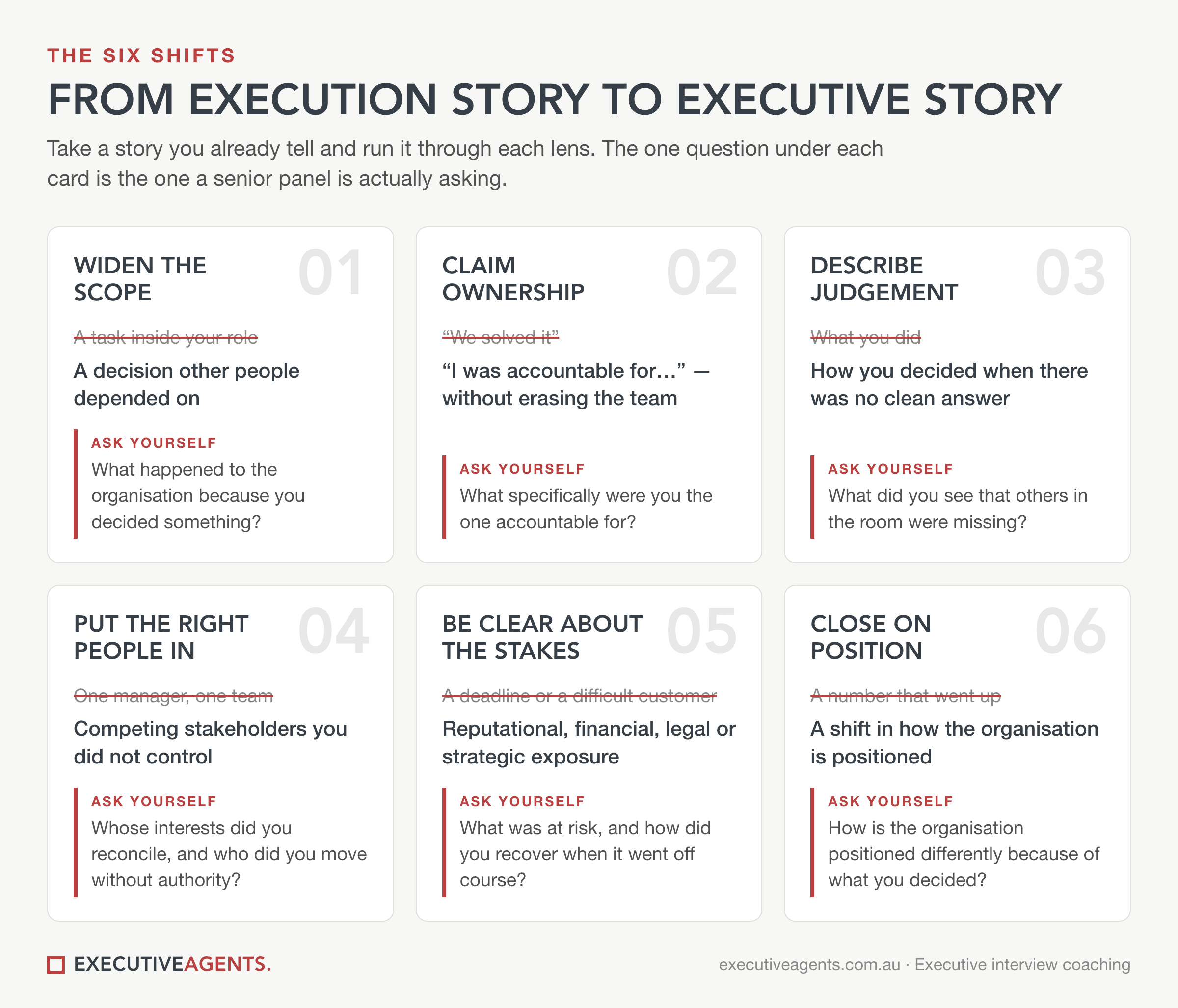
Widen the scope
An execution story solves a bounded problem inside your own role. An executive story shows a decision that changed an outcome other people depended on — P&L, board confidence, a risk the organisation avoided at scale.
Your verbs give you away before the content lands. Supported, executed and managed describe good work inside a system someone else built. Decided, positioned, reframed and shaped describe someone changing the system.
The question: what happened to the organisation because you decided something?
Claim ownership
Leaders who came up through collaborative cultures default to “we”. We solved it, we aligned the team, we got through it. The instinct comes from real humility and real team leadership, and nobody should coach it out of you entirely.
But the panel is not hiring “we”. Executive search firm BOB Search has been saying this for over a decade: if you only say “we”, the interviewer cannot tell what you personally did, so you receive no credit for it. The answer is both pronouns, used deliberately. Who convened the room? Who made the final call? Who owned the risk if it went wrong?
The question: what specifically were you the one accountable for?
Describe judgement, not actions
Mid-level stories can lean on process. Executive stories need to show how you think when there is no clean answer — which trade-offs you weighed and why. Most senior candidates have made hard calls and then flattened the story down to what they did rather than how they decided.
This is where trust is built. Taylor’s view is that boards build it through clarity of judgement rather than volume of achievement. The moment the panel needs to hear is the one where you saw something the rest of the room did not.
The question: what did you see in that moment that others were missing?
Put the right people in the story
A conventional story has one manager, one team, one audience. An executive story almost always involves competing stakeholders with different priorities, most of whom do not report to you. How you moved a room you did not control often matters more to the panel than the solution you eventually landed on.
Alignment is most persuasive when it involves tension. If everyone agreed from the start, it is not evidence of influence.
The question: whose competing interests did you reconcile, and who did you move without any authority over them?
Be clear about what was at stake
A deadline or a difficult customer is a mid-level stake. An executive story needs real exposure behind it — reputational, financial, legal or strategic. It should also include the moment things went off plan, because composure under real stakes tells a panel more than a flawless outcome ever will.
The question: what was at risk, and when it went off course, how did you recover?
Close on position, not a percentage
An execution story ends on a metric. An executive story ends on a shift in how the organisation is positioned — how the market, the board or the leadership team now sees it, or how differently your judgement is trusted from that point on.
CSG Talent’s STARR variant adds a Reflection step for exactly this reason: what the outcome meant for scalability, risk or long-term competitive advantage. The number still belongs in the story. It is just no longer the ending.
The question: how is the organisation, or how are you, positioned differently because of what you decided?
The story is already there
None of this means your existing executive interview stories are wrong. They may simply be built for a lower altitude.
The practical move is simple. Take the three or four stories you already tell and run each through the six lenses: scope, ownership, judgement, stakeholders, stakes and impact. Almost every senior candidate we work with already has the raw material for a strong executive narrative sitting inside an execution story they have been telling for years. The decision was there. The stakeholders were there. The judgement call was there. It never made it into the telling.
That is most of what executive interview coaching is, done properly: not inventing a better story, but finding the executive story inside the one you already have and rehearsing it at the height the panel is listening at. If you have a senior interview coming up and suspect your stories are proving the wrong thing, that is exactly what our sessions are for. If you would rather talk it through first, the initial consultation is free and there is no obligation attached to it.
Free download
Before the panel, prepare properly
Our executive interview guide covers what senior panels actually assess, the questions that decide it, and how to answer without sounding rehearsed. Free.