The Story That Gets You to Director Will Not Get You to the C-Suite

Most senior candidates arrive at an executive interview with three or four well-rehearsed stories. Clear situation, decisive action, measurable result. They have told those stories for years and the stories have worked.

Then they interview for a general manager, executive or C-suite seat and something misses. The feedback is polite and vague. The role goes to someone with a thinner track record.

Interview coach Lili Foggle put her finger on why in a piece for PARWCC this month: senior candidates prepare stories that prove they can execute, when what the panel is listening for is proof they can lead. We see the same thing in our own mock interviews, often enough that it is worth a post of its own.

The question changes at altitude

When a panel interviews a mid-level candidate, it is asking one thing: can this person do the work? A STAR-format story answers that well. It was built to.

When the same panel interviews an executive candidate, the question is different. Can this person’s judgement be trusted when nobody is checking? Boards already assume technical credibility at that level, as UK interview coach Mary Taylor points out; what they are evaluating is trajectory and judgement. Search firm CSG Talent makes the same point from the other side of the table — in senior interviews, what you made happen matters more than what you did.

Two candidates can have equally impressive records. One is categorised as someone who executes strategy, the other as someone who shapes it. That categorisation, more than the record itself, tends to decide who advances. Your stories are the evidence the panel uses to sort you — and in a market where executive vacancies are thinner than they were (we covered the numbers in July), each panel you reach carries more weight than it used to.

Foggle frames the fix as six shifts. All six hold up in practice. Each comes with one question worth putting to your own stories before the next executive interview.

Six shifts for the executive interview

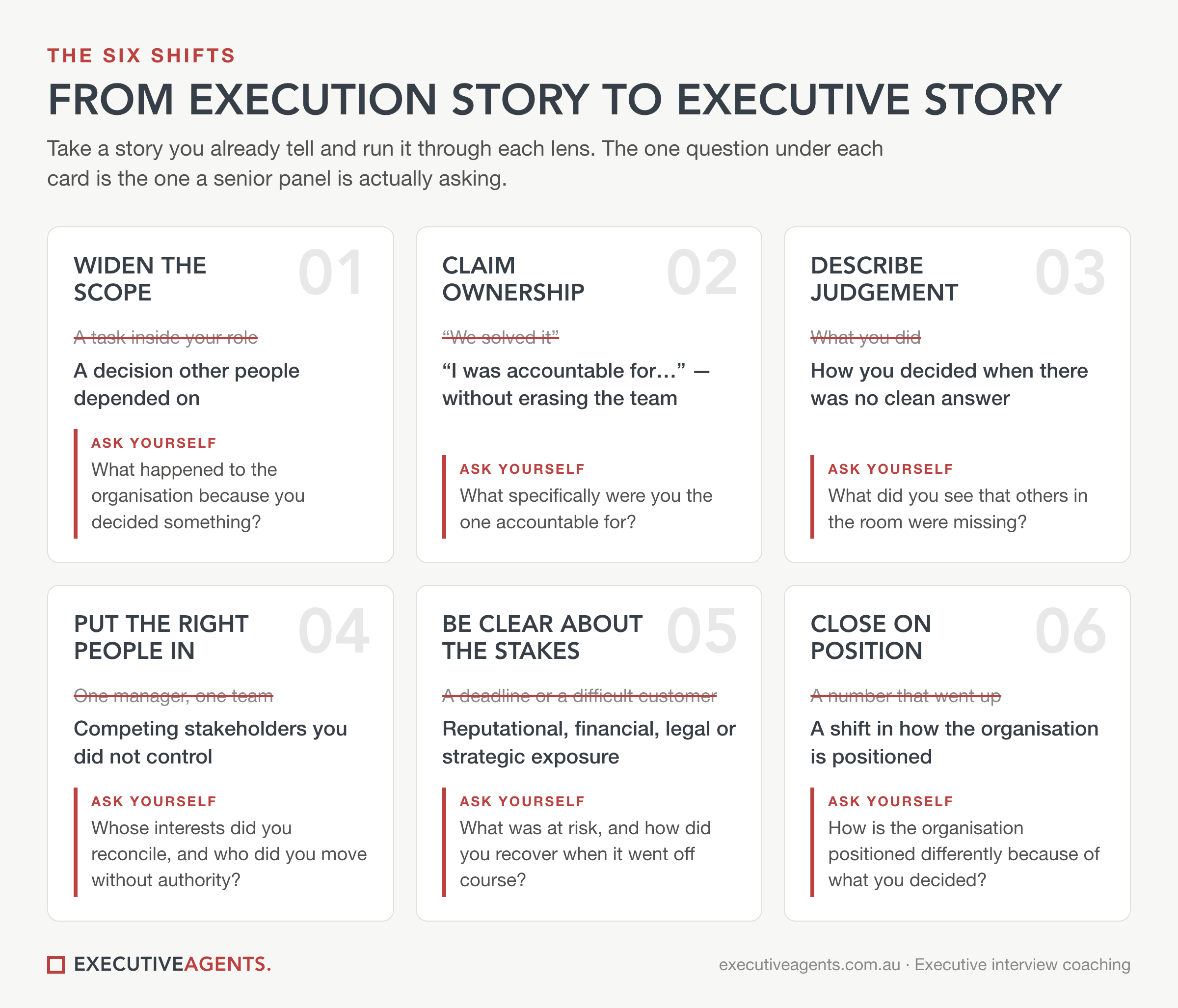
The six shifts that turn an execution story into an executive interview story: scope, ownership, judgement, stakeholders, stakes and impact
The six shifts. Run an existing story through each lens before the next executive interview.

Widen the scope

An execution story solves a bounded problem inside your own role. An executive story shows a decision that changed an outcome other people depended on — P&L, board confidence, a risk the organisation avoided at scale.

Your verbs give you away before the content lands. Supported, executed and managed describe good work inside a system someone else built. Decided, positioned, reframed and shaped describe someone changing the system.

The question: what happened to the organisation because you decided something?

Claim ownership

Leaders who came up through collaborative cultures default to “we”. We solved it, we aligned the team, we got through it. The instinct comes from real humility and real team leadership, and nobody should coach it out of you entirely.

But the panel is not hiring “we”. Executive search firm BOB Search has been saying this for over a decade: if you only say “we”, the interviewer cannot tell what you personally did, so you receive no credit for it. The answer is both pronouns, used deliberately. Who convened the room? Who made the final call? Who owned the risk if it went wrong?

The question: what specifically were you the one accountable for?

Describe judgement, not actions

Mid-level stories can lean on process. Executive stories need to show how you think when there is no clean answer — which trade-offs you weighed and why. Most senior candidates have made hard calls and then flattened the story down to what they did rather than how they decided.

This is where trust is built. Taylor’s view is that boards build it through clarity of judgement rather than volume of achievement. The moment the panel needs to hear is the one where you saw something the rest of the room did not.

The question: what did you see in that moment that others were missing?

Put the right people in the story

A conventional story has one manager, one team, one audience. An executive story almost always involves competing stakeholders with different priorities, most of whom do not report to you. How you moved a room you did not control often matters more to the panel than the solution you eventually landed on.

Alignment is most persuasive when it involves tension. If everyone agreed from the start, it is not evidence of influence.

The question: whose competing interests did you reconcile, and who did you move without any authority over them?

Be clear about what was at stake

A deadline or a difficult customer is a mid-level stake. An executive story needs real exposure behind it — reputational, financial, legal or strategic. It should also include the moment things went off plan, because composure under real stakes tells a panel more than a flawless outcome ever will.

The question: what was at risk, and when it went off course, how did you recover?

Close on position, not a percentage

An execution story ends on a metric. An executive story ends on a shift in how the organisation is positioned — how the market, the board or the leadership team now sees it, or how differently your judgement is trusted from that point on.

CSG Talent’s STARR variant adds a Reflection step for exactly this reason: what the outcome meant for scalability, risk or long-term competitive advantage. The number still belongs in the story. It is just no longer the ending.

The question: how is the organisation, or how are you, positioned differently because of what you decided?

The story is already there

None of this means your existing executive interview stories are wrong. They may simply be built for a lower altitude.

The practical move is simple. Take the three or four stories you already tell and run each through the six lenses: scope, ownership, judgement, stakeholders, stakes and impact. Almost every senior candidate we work with already has the raw material for a strong executive narrative sitting inside an execution story they have been telling for years. The decision was there. The stakeholders were there. The judgement call was there. It never made it into the telling.

That is most of what executive interview coaching is, done properly: not inventing a better story, but finding the executive story inside the one you already have and rehearsing it at the height the panel is listening at. If you have a senior interview coming up and suspect your stories are proving the wrong thing, that is exactly what our sessions are for. If you would rather talk it through first, the initial consultation is free and there is no obligation attached to it.

Free download

Before the panel, prepare properly

Our executive interview guide covers what senior panels actually assess, the questions that decide it, and how to answer without sounding rehearsed. Free.

LinkedIn Profile Optimisation Is Not LinkedIn Profile Writing

A well-written LinkedIn profile and a findable one are not the same object. LinkedIn profile optimisation and LinkedIn profile writing now describe different work, and for most of the last decade you could ignore the distinction, because one job produced both results. You cannot ignore it now.

The reason is narrow and specific. In June 2026, LinkedIn’s engineering team published an account of the system that sits behind Hiring Assistant, its recruiter agent. Reading it changes what you would sensibly do to your own profile — and it contradicts something we published on this site last year.

First, a correction

In our post on LinkedIn trends we wrote that a recruiter’s search is “a keyword-and-filter query, not a browse”. That was a fair description of the mechanism at the time. It is no longer a complete one, and the part it gets wrong is the part that matters most to a senior candidate.

We are correcting it here rather than quietly editing it, for the same reason that post existed: it was itself a correction of an earlier edition that had forecast things we could not check. A firm that sells judgement should show its working when the evidence moves.

What LinkedIn actually built

The engineering post — Semantic Search for AI Agents at Scale, published 11 June 2026 — describes a platform called MUSE, for Member Understanding Semantic Embeddings. Its job is to score more than a billion member profiles in real time against a recruiter’s description of who they want.

Start with the query, because that is what changed first. LinkedIn’s own framing: when a recruiter describes who they are looking for, “they rarely type three keywords into a search box”. They write something like licensed nurse practitioner, 3+ years in pediatric care, bilingual Spanish preferred — and “very often it’s a full paragraph”.

Then the two sentences that should reorganise how you think about your profile. Keyword matching, LinkedIn says, “fails because the same qualification can be described in dozens of ways”. And attribute filtering “fails because many qualifications — problem-solving ability, cross-functional leadership, domain expertise — don’t map to structured fields at all”.

That is the platform stating plainly that the two things most profile advice optimises for — the right keywords, the right boxes ticked — were insufficient for the search it wanted to build.

What the system is actually deciding

Here is the part worth slowing down on, because it is the whole distinction between writing and optimisation.

LinkedIn describes the judgement its system has to make as “complex, requiring multi-step reasoning”, and gives an example. Does the claim “Enabled 700+ events and 150+ ticketing deployments” satisfy a requirement for “Experience in building consumer-grade products at scale”?

Sit with that. It is not asking whether your profile contains the phrase “consumer-grade products at scale”. It is asking whether the thing you said you did constitutes evidence of the thing the recruiter asked for. A model reasons from your claim to their requirement, and decides whether the bridge holds.

Which means a profile can fail in two directions that look nothing alike.

It fails if your achievements are described in language so internal that nothing maps — a genuinely large piece of work rendered as “led BAU transition for Program 4B”. And it fails if your language is so smooth and general that there is no specific claim to reason from. “Transformational leader with a track record of driving results” contains no evidence. It is not that the model dislikes it. There is nothing in it to evaluate.

Elegant prose written to impress a human reader is very good at producing the second failure. That is the trap. The better the writing, in the conventional sense, the more likely it is to be smooth, general and evidentially empty.

How much of search this actually is

A caveat the marketing posts about all this tend to skip, and it matters for calibration.

Semantic search has not replaced everything. In LinkedIn’s own reported results, semantic retrieval’s share of surfaced candidates rose from 18% to 31%. That is a large shift and it is still under a third. Boolean and faceted strategies continue to operate alongside it.

So the honest position is not “keywords are dead”. It is that a profile now has to satisfy two different readers at once: a filter that still runs on exact terms, and a reasoning layer that assesses whether your described experience supports a stated requirement. Optimising for either one alone leaves the other unserved. Anyone selling you a single trick is describing a third of the problem at best.

What LinkedIn profile optimisation involves

With that established, the work becomes specifiable rather than mystical.

Claims have to carry evidence, not adjectives. Every significant line should contain something a reasoning model can test against a requirement: scope, constraint, decision, result. “Rebuilt procurement across 14 sites during an ERP migration, cutting cycle time 38% in eighteen months” can be reasoned about. “Extensive procurement transformation experience” cannot. The first is also better prose, which is the happy part.

The vocabulary has to be the role’s, not your employer’s. Internal titles and program codenames are invisible. If your sector calls it clinical governance, your profile says clinical governance, whatever the org chart calls it. This is not keyword stuffing — it is the difference between a claim that maps to a requirement and one that does not.

Skills are structured data and should be treated as such. LinkedIn permits up to 100 skills on a profile, per its own help documentation. That is a field the filters read directly. The discipline is not filling it — it is curating it, so the terms present are the ones you want to be searched on and the residue from a previous career is gone.

The resume and the profile have to agree. Not in wording, in fact. Employers, dates, titles, scope. Discrepancies used to read as untidiness; in a market where verification has tightened, they read as something worse, and you are not in the room to explain.

Coverage matters more than polish in the experience section. A role summarised in one line cannot be reasoned about at all. Every role you would want to be found for needs enough substance to support an inference.

And timing is real. This is the detail almost nobody accounts for. LinkedIn’s serving architecture refreshes profile embeddings on a daily job that detects new and updated profiles, with a full rebuild of the index on a weekly cadence. Your edits are not instantaneous, and they are not indefinitely delayed either. Rewrite a profile the night before a search consultant runs their longlist and the machine may still be reading the old you. Plan the change a week or two ahead of the moment you need it working.

The market has already renamed it

We pulled twelve months of Australian search volumes to July 2026, and the demand side has moved before most of the supply side noticed.

Two clusters moved in opposite directions. Terms built around the word writer or writing service fell hard — the first by 89%, the second by 67%. Terms built around optimisation climbed just as steeply: the plain term up 125%, linkedin search optimisation up 150%, and linkedin profile optimisation tool up 400% from a small base.

The reading is not that interest collapsed. It is that buyers stopped classifying this as a writing problem. A chatbot will return a serviceable summary on request, and senior professionals worked that out some time ago, which drained the scarcity out of the drafting. What stayed scarce is knowing whether the result will surface.

The pressure this creates is visible from the hiring side too. LinkedIn reports that recruiters using Hiring Assistant review 81% fewer profiles to find a qualified match, a figure it attributes to its own data from January 2026. Invert that and it describes your side of the transaction: roughly four in five profiles that would once have reached a human are now screened out upstream of one, and nothing tells you yours was among them.

What we would do

If you are doing this yourself, in this order:

  • Rewrite your headline as a claim, not a job title. It is the most heavily weighted short field you control and most senior people spend it restating what their business card says.
  • Put a number and a constraint in every role. One sentence per role that a stranger could test. That single change does more than everything else on this list combined.
  • Translate every internal term. Read your profile as someone outside your organisation. Anything that requires your org chart to decode, replace.
  • Cull the skills list, then rebuild it from the language of the ads you would actually apply for.
  • Reconcile the profile against your resume line by line — employers, months, titles.
  • Make the changes at least a fortnight before you need them working.
  • Then leave it alone. Posting daily to satisfy a feed is a different project from being findable, and conflating the two is how people spend six months busy and still unfound.

That is a real day of work done properly, and for a lot of people it is enough.

When it is worth paying someone

The case for handing it over is not that the writing is hard. It is that the extraction is.

Almost nobody can supply their own evidence unprompted. Ask a chief operating officer what they achieved and you will get the responsibilities. The number that moved, the constraint they worked under, the decision that was actually theirs — those come out under questioning, from someone who knows which thread to pull and does this every day. That is the part a template cannot do and a chatbot cannot do, because neither of them knows what to ask you next.

Our executive LinkedIn profile optimisation service is built around that interview. We work for both audiences on purpose: the retrieval layer that determines whether you are shown at all, and the human who forms a view of you thirty seconds later. Australian team, Australian senior market.

Where the resume needs the same treatment, our executive resume writing service draws on the identical interview. Clients commonly take both, largely so the two documents cannot contradict each other.

One last thing

The uncomfortable implication of LinkedIn’s own description is that the filtering is silent. A profile that fails to surface produces no bounce, no rejection, no signal at all. You simply receive fewer approaches than you would have, and you attribute it to the market.

That is worth knowing even if you never hire anyone to fix it.

Sources: LinkedIn Engineering, “Semantic Search for AI Agents at Scale: Retrieval and Ranking for LinkedIn’s Hiring Assistant”, 11 June 2026 (MUSE architecture, query behaviour, qualification reasoning, retrieval share, refresh cadence). LinkedIn Talent Solutions, Hiring Assistant product page (81% fewer profiles reviewed; based on LinkedIn data, January 2026). LinkedIn Help, “Add and remove skills on your profile” (100-skill limit). Australian search volume movements: Google Keyword Planner, Australia, August 2025 – July 2026. All sources read 28 August 2026.

The AI Job Interview — What Changed, And What Panels Now Ask

The resume stopped being evidence. The interview became the only place left to prove anything.

That is the whole shift, and most candidates have not adjusted to it. They are still preparing for an interview that confirms what the application already said. The AI job interview is not a new kind of interview — it is the old one, asked harder. The panel is trying to establish whether the person in the room is the person on the page, and whether either of them can do the job. The questions have changed accordingly, and so has the room they are asked in.

THE APPLICATION STOPPED CARRYING INFORMATION

Employers did not decide the resume was worthless. They worked out it no longer separates anyone.

Gartner surveyed 3,290 job candidates in the fourth quarter of 2024 and found 39% had used AI during the application process. Of those who did, 54% used it to generate text for their resume or CV, 50% for a cover letter, 36% for a writing sample, and 29% to generate answers to questions on an assessment.

Read that last figure again. Nearly a third of AI-using candidates were not polishing a document — they were generating answers to the employer’s own assessment. That is the point at which a screening tool stops measuring anything about the candidate.

Jobs and Skills Australia put the structural version of this plainly. “Artificial intelligence is now the first gatekeeper in hiring,” wrote Deputy Commissioner Megan Lilly in March 2026. “In practice, machines often decide the applicants that will be reviewed by the recruiter.”

So both ends of the process have been automated. Candidates generate applications, employers screen them by machine, and the written stage now largely measures who has the better tooling. Everyone involved knows it. The consequence is that the weight of the decision has moved to the one stage that is hard to automate — the conversation.

THE INTERVIEW CAME BACK INTO THE ROOM

The most visible change is physical. A Gartner survey reported by Computerworld in August 2025 found 72.4% of recruiting leaders were conducting interviews in person to combat fraud — the figure behind our interview coaching page. Google, Cisco and McKinsey had each reinstated in-person interviews for some candidates.

What that number does not tell you is why, and the three companies did not give the same answer.

Cisco framed it as security. “Remote work and advancements in AI have made it easier than ever for fake candidates to infiltrate the hiring process,” said Scott McGuckin, its vice president of global talent acquisition. McKinsey framed it as signal: face-to-face interaction is “necessary to assess the human qualities that can’t be automated … things like judgment, empathy, creativity, and connection.” Google simply banned the use of AI tools during virtual interviews.

Gartner analyst Emi Chiba named the practical advantage: an in-person interview “makes it much easier to enforce an AI-free zone in real time.” Chiba also gave the scale of the problem — clients hiring for remote IT roles, she said, “can expect at least half of the applications received on that role to be false.”

Here is the part candidates find surprising. Being asked to attend in person is not a bad sign, and candidates appear to prefer it. Gartner found 62% of candidates said they were more likely to apply to a position if the organisation required in-person interviews. When the written stage proves nothing, a process that tests you properly is a process where being good is worth something.

None of which means video interviewing is finished. It is not — HireVue alone reported close to three million video interviews in a single quarter. But the balance has shifted, later rounds have hardened, and if you are a senior candidate you should now assume that at least one stage will be unassisted and observed.

THE QUESTIONS CHANGED SHAPE, NOT SUBJECT

This is the part that gets misreported. Panels have not invented a new category of question. They have stopped accepting the first answer.

The traditional behavioural question — tell me about a time you led a team through change — is now the opening of a sequence rather than a question in itself. Generative AI answers that opening extremely well. What it cannot do is survive four follow-ups into the specifics of something you did not do.

So the structure of an AI job interview has changed from a set of questions to a set of descents. Expect:

  • Constraint probing. What limits were you working under — budget, timeline, legacy systems, industrial agreements, a board that had already decided? How did those change your approach?
  • Measurement probing. What number moved, by how much, over what period, and how did you know it was you rather than the market?
  • Counterfactual probing. What would you do differently, and what did it cost you to learn that?
  • Dissent probing. Who disagreed with you, what was their argument, and were they partly right?

Every one of those is answerable in detail by someone who was there, and answerable only in generalities by someone who was not. That asymmetry is the entire design.

Joel Wolfe, who runs the outsourcing firm HiredSupport, described the pattern precisely. His team screens with Socket.io, an uncommon JavaScript library that requires hands-on experience. Candidates began acing the quizzes — then could not explain the reasoning behind their own answers. “That’s the giveaway,” he said. “They’re using AI tools like ChatGPT to cheat through the early rounds, parroting answers without real understanding. Once we go deeper, the knowledge falls apart.”

The executive equivalent is not a coding library. It is the question about the restructure you say you led, asked for the fourth time, at a level of detail that only the person who ran it could reach.

THE PROBES DESIGNED TO CATCH AI USE

Some techniques are aimed squarely at detecting assistance rather than assessing capability. Recognising them matters, because they behave differently from ordinary questions and they unsettle people who are not expecting them.

The unannounced specific. A question about a detail on your own resume that no general answer covers — the reporting line in a role from 2019, why a project ended when it did, who replaced you. There is no way to prepare a plausible answer to a fact about your own life you cannot remember.

The live artefact. You are shown something on screen — a set of numbers, a one-page brief, a board paper extract — and asked to react to it now. Real-time interpretation of material you have never seen removes the gap in which assistance would happen.

The deliberate interruption. You are cut off mid-answer and redirected. A rehearsed or fed answer has a shape, and the shape breaks when the sequence does. This is also, incidentally, a legitimate test of how you handle a hostile board.

The reversal. You have just given a polished answer. The panel asks you to argue the opposite position, or to explain why someone sensible would have disagreed. Fluency without ownership fails here.

The format tell. Panels are being trained to notice answers that arrive as spoken bullet points — three neatly parallel items, evenly weighted, no digression. People who lived through something do not narrate it in a structure. They start in the middle, correct themselves, and remember a detail late.

That last one deserves a warning, because it cuts both ways. Heavily rehearsed candidates now sound like AI. If you have drilled a STAR answer until it is frictionless, you have optimised for the thing panels are currently using as a red flag. Preparation still matters enormously. Polish, past a point, has become a liability.

WHAT IS PERMITTED IN AN AI JOB INTERVIEW IS BEING WRITTEN DOWN

The most useful development for candidates is the least discussed: employers are starting to state the rules.

Cisco’s position is that AI can be used in interviews where relevant, such as during specific exercises, and candidates are told when. Its default is explicit — “if a candidate is not explicitly invited to use AI during the assessment process, then it should be considered off-limits.” Chiba’s argument to employers runs the same way: it is unrealistic to demand an AI-free hiring process while expecting employees to be skilled in the technology at work, so organisations should say plainly which parts of the process permit AI and which are reserved as AI-free.

The practical implication is simple. Ask. “Is there any part of this process where you would prefer I not use AI tools?” is a question that costs nothing, signals that you take the issue seriously, and gives you a defensible position either way. Candidates almost never ask it. The ones who do tend to be remembered well for it.

WHAT THIS LOOKS LIKE IN AUSTRALIA

Two Australian specifics are worth holding onto.

The first is that skills-based hiring is displacing credential-based hiring here faster than the public conversation suggests. Hays research cited by Jobs and Skills Australia found 85% of hiring managers report skills gaps and 86% are turning to skills-based hiring to address them, though only 64% say it is currently meeting expectations — the gap being the difficulty of actually assessing skills. Jobs and Skills Australia has proposed a National Skills Taxonomy to address that, with trials getting underway and the main rollout beginning from mid-2026.

Where employers cannot verify a skill from a document, they verify it in conversation. That is exactly the pressure being applied to interviews now.

The second is Lilly’s forecast, which reads as a direct instruction to senior candidates: “the way we describe skills will dramatically change as a result of AI and automation meaning applicants will need to be more comfortable in explaining their abilities.”

Explaining, not listing. The document is not the deliverable any more.

THE DEMAND SIGNAL NOBODY HAS PUBLISHED

There is a way to see this shift happening in real time, and as far as we can establish nobody has reported it.

Australian Google search volumes for the twelve months to July 2026 show two opposite movements. Searches for interview answers are collapsing. Searches for interview help are climbing.

Down year on year: “interview advice” −45%, “interview preparation” −56%, “common interview questions and answers” −57%, “behavioural questions and answers” −65%.

Up year on year: “executive interview coaching” +100%, “mock interview practice” +80%, “medical interview coaching” +40%, “job interview coach” +29%.

Nobody needs to search for a sample answer any more, because a chatbot will write one in four seconds. What people cannot get from a chatbot is the experience of being interrupted, pushed and disbelieved by a person while they try to hold a position. So the informational demand has evaporated and the rehearsal demand has roughly doubled.

Our own enquiries for interview coaching are up 73% this year. We had assumed that was a marketing outcome. The search data suggests it is a market change.

WHAT WE WOULD DO

Rebuild four stories to depth, not twelve to the surface. For each: the constraint you were under, the number that moved, the person who disagreed, and what you would do differently. Depth is the only defence against descent questions, and four is realistically all you can hold.

Go and find the numbers now. Before you leave, or while the reporting still exists. Executives routinely lose access to the evidence for their own achievements on the day they hand back the laptop, and no amount of preparation reconstructs a figure you never wrote down.

Rehearse being interrupted. Not the answer — the recovery. Have someone cut you off at thirty seconds and redirect you. If your answer only works uninterrupted, it will not survive a panel.

Deliberately un-polish. Keep the hesitation where you genuinely have to think. Say which part you are less sure about. The panel is listening for a human, and slight roughness now reads as authenticity where it used to read as under-preparation.

Ask what is permitted. Once, early, in writing if you can. Then follow it exactly.

Assume one round will be in person and unassisted. Preparing for an AI job interview means preparing as though the notes will not be there, because increasingly they will not be.

ONE LAST THING

There is an obvious irony in a firm that writes executive resumes telling you the resume no longer decides anything. Both things are true. A weak application still ends the process early — it just cannot finish it any more. The document buys you the room. What happens in the room is now decided almost entirely by whether you can talk about your own work in detail, under pressure, without help.

That is a good change for people who have actually done the work. For fifteen years the advantage sat with whoever presented best on paper. It has moved to whoever can be questioned hardest without coming apart. If you have run the restructure, carried the P&L and taken the board through the bad quarter, the new format is on your side.

It only requires that you can prove it out loud.

Our interview coaching runs sessions as real interviews — you are interrupted, pushed and asked follow-ups, by two of our practitioners, one on pressure and one on what panels actually ask. If you would rather start with the written side, our executive resume writing service exists for that. The initial consultation is free and there is no obligation attached to it.

SOURCES

Strategy Presentations as a CEO Candidate: What Boards Actually Ask For

Boards set the strategy and hire you to execute it. What a final-round CEO presentation should contain, and the confidentiality trap that ends candidacies.

Pathways to Getting on a Board

Most first board seats are unpaid, and the legal duties are not. What a first directorship actually involves in Australia, and how people get one.

What are Asynchronous Video Interviews?

What Are Asynchronous Video Interviews? We Sat Some and Got Scored

By Anna Daly
August 9th, 2023

In August 2023 we recorded a set of asynchronous video interviews ourselves, on a platform called Interviewer.AI, using invented applications, to find out what the scoring actually rewards. One of them came back with 52 per cent for dress.

Here is what we found, what has changed since, and what Australian law will — and will not — require anyone to tell you.

What an asynchronous video interview is

An asynchronous video interview, or AVI, sometimes sold as an AI interview or a one-way interview, is a recording rather than a conversation. The employer sets the questions in advance. You record your answers alone, into a camera, usually against a timer of about a minute per question and often with a limited number of takes. Nobody is watching while you do it. The recording is then scored — sometimes by software, sometimes by a person reading a software-generated summary — and passed on, or not.

It sits between the application and the first real interview, and its purpose is to reduce a large pile of applicants to a small one without anyone’s diary being involved.

What happened when we recorded them

One recording, made deliberately casually — a ponytail, a gingham scarf, a collarless top — came back with 52 per cent for dress and 39 per cent for presentation.

We also scored badly on a category the platform called Sentiment, which was the correct result: the applications were make-believe and the enthusiasm was fake. Whatever else these systems measure imperfectly, one of them was measuring conviction, and it caught us.

The numbers are three years old. What they describe is not. As at August 2026, Interviewer.AI’s own published score breakdown still lists Professionalism among its five scoring areas, and still divides it into Dressing — “how formally you are dressed for the interview” — Grooming, “well-groomed and presentable” — and Body Language: “eye contact, posture, and use of hand gestures”. A second category, Sociability, includes “facial expressions and emotional openness”. The company describes 41 separate models measuring observable features including eye contact, emotional state and energy level.

We were marked on our scarf, and the marking scheme is still published.

The part that should give you pause

In January 2021, HireVue — the largest platform in this market, and the one Angelo Capuano reported in The Conversation in December 2023 was in use by more than a hundred employers including Telstra — announced it would stop using visual analysis in its pre-hire algorithms altogether. Its stated reason was not ethics but accuracy: appearance had far less correlation to job performance than language, and adding visual data to language data produced no extra predictive power. The company said it hoped the decision would become an industry standard.

It did not. Five and a half years later, a competitor in the same category still scores how formally you are dressed and how well groomed you look.

Both positions are published by the companies themselves. They cannot both be right about whether appearance predicts performance. And when an employer sends you a link, you are not told which of the two you are about to record into, what it weighs, or whether anyone has ever tested it against Australian candidates.

What we said in 2023, revisited

We speculated then that these systems are trained largely on US data, and that Australian reserve would score badly against them. We flagged at the time that we had no evidence. Some has since accumulated, and it points at something more specific — and more mechanical — than we guessed.

Interviewer.AI is a Singapore company. That tells you very little about what its models learned from, because almost nobody builds a speech recogniser from scratch. Vendors build on the same English-language stack everyone else uses, and that stack is measurably better at American English than at ours. Testing OpenAI’s Whisper across accent groups, Graham and Roll found Australian English produced significantly higher error rates than American English (JASA Express Letters, February 2024). Across six commercial recognisers — Amazon, Apple, Google, IBM, Microsoft and Kaldi — Tadimeti, Georgila and Traum measured non-American accents running roughly 16 to 49 per cent worse in relative terms than General American. That second study did not test Australian English; the Whisper study did, and found the same direction of effect.

This matters more than it looks. Three of the things Interviewer.AI scores — Articulation, Grammar and Sentiment — are language scores, and a language score is computed from a transcript. If the transcript is wrong more often for an Australian voice than an American one, every score built on top of it inherits the error. You are not being marked down for how you speak. You are being marked down for what the machine thought you said.

There is an irony in it worth sitting with. HireVue’s stated reason for switching the camera off was that language carries the predictive weight, not appearance. If that is right, and the language layer is the accent-sensitive one, then turning the camera off concentrates the problem rather than solving it.

No vendor in this market publishes its error rates broken down by accent. Nobody in Australia is required to ask for them.

Where the law actually stands

Three dates matter, and they do not point the same way.

December 2025. The Federal Government released the National AI Plan on 2 December 2025 and abandoned its earlier intention to legislate mandatory guardrails for high-risk AI. AI in hiring is now governed by the laws already on the books rather than by anything purpose-built.

Now. There is no general requirement for a private-sector employer to tell you that AI was used to assess you, or to explain how. Anti-discrimination law still applies — but as JobWatch put it in February 2026, an applicant has to prove discrimination occurred, and with an algorithm in the way, working out how and why a rejection happened becomes significantly harder. Applicants also sit outside most workplace protections, which are built for employees.

10 December 2026. From that date, Australian entities that use personal information in automated decision-making capable of affecting your rights or interests must say so in their privacy policy, including the kinds of information used and the kinds of decisions made. It does not give you a right to an explanation of your own result, and it does not stop the practice. What it does mean is that from December, an employer running an AI interview should be saying so in writing, somewhere you can read it.

Until then, the honest position is that you are being scored by a system nobody is obliged to describe to you.

Infographic Video Resume Pros and Cons
How to record one well

Write the answers first. The format does not reward spontaneity. You will have roughly a minute per question and little or no opportunity to restart, so draft responses to the questions that always come — your interest in the role, what you would add to the organisation — and anchor each one in a specific example.

Then cut them. A minute is short. One example per answer, delivered steadily, beats four ideas at speed. The most common failure we saw was trying to fit an entire career into sixty seconds.

Rehearse out loud, not in your head. Reading silently tells you nothing about whether you can say it in the time.

Dress as you would for the interview this replaces. A plain collared shirt, a jacket, hair that stays put when you move your head. You should not need a stylist. Assume appearance is being scored — on at least one platform it demonstrably is, under the heading Professionalism, and you will not be told in advance which platform you are on.

Mean it. Sentiment was the one category that read us accurately, and it is not incidental: Positive Attitude is one of the five scoring areas, and sentiment appears again inside two of the others. Enthusiasm you do not feel is detectable. If you cannot summon any for the role, that is information worth acting on yourself.

Find out whose software it is. If the platform is named in the invitation, look it up. Several publish their scoring categories openly, and reading them takes five minutes. Knowing whether appearance is on the list changes how you prepare.

And keep the written application good

AVIs are becoming a routine screening step, not a replacement for everything else. Hybrid processes are the norm: the video gets you past the first cut, and the written material still does the work of making the case. Both have to be right.

If you want to practise the format before it counts, our executive interview coaching covers it.


Want to test your AI interview technique?

Get the Executive Kickstarter.

Perfect for people who want an impeccable CV, LinkedIn profile, and covering letters for powerful job applications.

Powerfully Preparing for the Job Interview

Powerfully Preparing
for the Job Interview.

Here at Executive Agents we see a number of really exceptional clients fall-down at the interview stage. They may have all the qualifications and experience in the world, but if they cannot interview well, they might as well kiss the job of their dreams goodbye. Here are some powerful and effective things to consider when preparing for your next interview.

NOT SURE WHICH PACKAGE YOU NEED?

TAKE OUR FREE 5-QUESTION PACKAGE FINDER.

COME OVER-PREPARED.


You can never arrive at an interview too prepared. Research everything, come with enough background information to be able to generate independent thought and be prepared to show that in the interview. Do you know the career history of your interviewer? All these things can really give you the edge over the other candidates. Speak to Executive Agents for help becoming over-prepared!

Review Of Top 10 Free Online Resume Builders

RESEARCH THE COMPANY.


Did the profits of the hiring company go up or down last financial year? What were the key points of the last quarterly result announcements? How will the new emissions trading scheme announced by the government impact the business? Speak to Executive Agents for detailed insight on the hiring company.

RESEARCH THE INTERVIEWER.


Who’s interviewing you? Where did they start their career? What are they responsible for now? What are their key skills? Knowing these things can help you set up for the interview really powerfully. Speak to Executive Agents for help researching your interviewer.

COME WITH IDEAS.


Love their new red widget? What if you could buy it with the blue widget and appeal to an even larger market? They don’t have to like the ideas, actually, you don’t even need to like the ideas. It’s an opportunity to demonstrate critical thinking, creativity and an interest in the company. Speak to Executive Agents to obtain the information and inspiration necessary to develop unique and valuable ideas.

GIVE ONE TO TWO MINUTE RESPONSES.


Don’t waffle on! This bores the interviewer and curtails the number of questions they can ask you! Communication is the key to successful interviewing. Being succinct and to the point is a valuable skill in today’s busy workplace so not only will your interviewer be able to cover everything they want, they will also see another facet of your value proposition.

BE SPECIFIC AND ILLUSTRATE RESPONSES WITH EXAMPLES.


Support statements about yourself with specific examples. These will provide legitimacy to your claims. Without them, the interviewer may not accept them as valid. See it as an opportunity to embellish your long list of achievements.

BE FRIENDLY, BUILD RAPPORT AND CONNECT.


Your interviewer already knows what degrees you have and what your technical skills are: they’ve read your CV. Face-to-face interviews are a time to build the ‘human’ case for hiring you. This is an opportunity to build rapport and connection with the interviewer. Flirt, charm and use your wit to win them over!

CLEARLY STATE YOUR INTEREST.


The team here at Executive Agents is regularly surprised by the number of interviews where the interviewer comes out with a concern that the candidate is not even interested in the role. Remember to reiterate towards the end of interview that you are very interested in the role and why.

The dedicated team at Executive Agents is there to help you in all these areas.

Still doing all this on your own? Get our support now.


NOT SURE WHICH PACKAGE YOU NEED?

TAKE OUR FREE 5-QUESTION PACKAGE FINDER.


Questions to never ask in a job interview

Questions to never ask
in a job interview

NOT SURE WHICH PACKAGE YOU NEED?

TAKE OUR FREE 5-QUESTION PACKAGE FINDER.

Resume Writing Services Near Me

Ever been in a job interview that is just going so well that you’re almost certain you’ve won the role? Don’t get too ahead of yourself and screw the whole thing up by asking the following questions:



  • Don’t ask questions you could’ve found the answer to on Google.
  • Never ask to change the scope of the role, hours worked or package. Speak to your Executive Agent prior to the interview for the best was to deploy such requests.
  • Don’t bring up or refer to gossip.
  • Don’t ask too many questions about the interviewer. They’re there to interview you.
  • Don’t ask if they do background checks or reference checks. Let them bring it up.
  • Don’t ask about closely related roles and whether you can move into those quickly.
  • Don’t ask about how quickly you can be promoted unless it’s a natural progression. I.e. more responsibility within the current salary.

Are you likely to present strongly in your next interview?

TAKE OUR FREE 5-QUESTION PACKAGE FINDER.